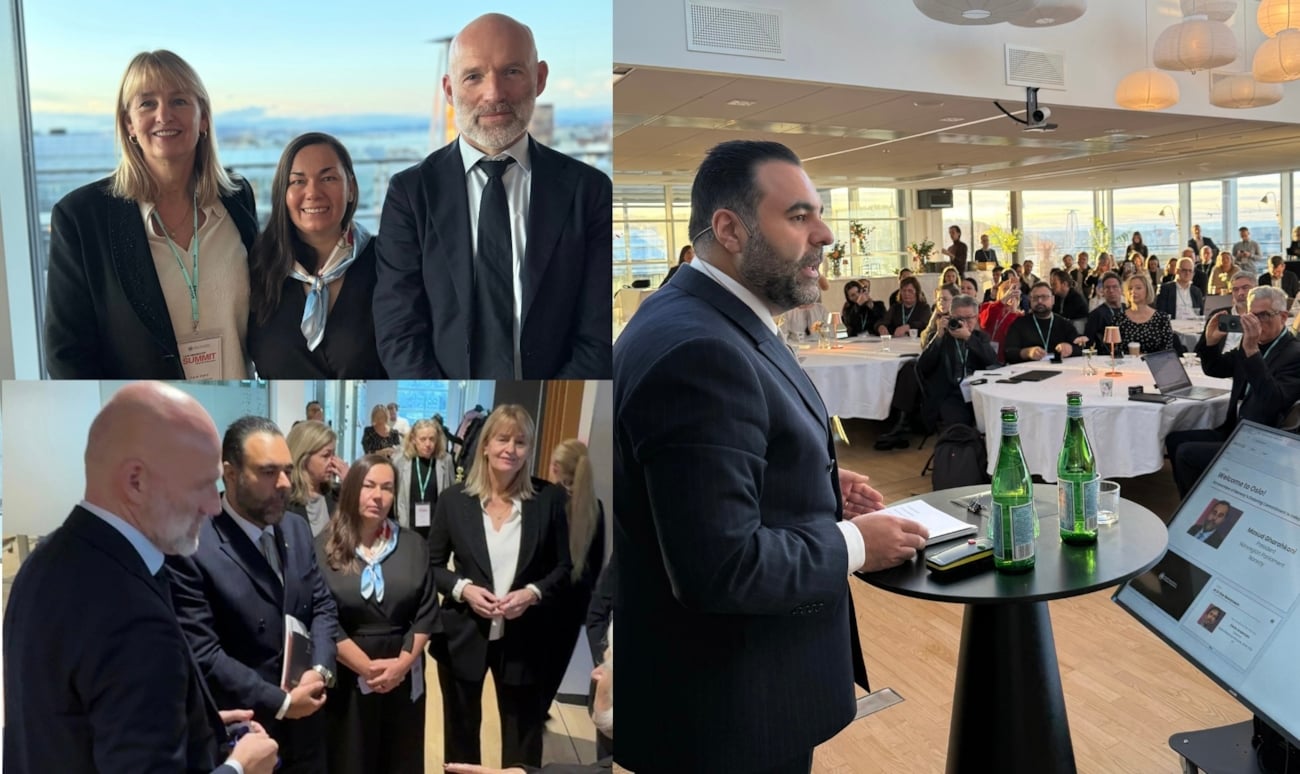
The President of the Norwegian Parliament, Masud Gharahkhani, opened the conference and reminded us of the purpose behind this work.
Here is his full speech:
Dear editors, Dear friends,
Welcome to Norway. Welcome to Oslo.
It’s a great pleasure to open this conference. For me, this gathering is about more than journalism and the media.
It’s about freedom. It’s about democracy.
And it’s about the fundamental right to speak your mind.
I was born in Iran, a country where freedom of expression and freedom of the press do not exist as we understand them in Norway.
My parents belonged to a generation that hoped the Iranian Revolution of 1979 would bring more freedom and more democracy.
It did not.
When I was five years old, my parents made a life-changing decision. They left behind family, friends, and everything they knew to give me the chance to grow up in freedom. Starting over in a new country was not easy. But we were welcomed with open arms.
In Norway, we were given opportunities that millions of people around the world are still denied today. As a child, I often asked why Norway and Iran were so different. Both countries have natural resources. Both countries have proud histories.
But over time I realized that the most important difference had nothing to do with geography or resources. It had everything to do with the choices we make as a society.
In Norway, we have built a society based on trust. A society that welcomes knowledge and debate. A society built on the belief that an open and informed public debate makes us stronger.
That is why I never tire of talking about the Norwegian Constitution.
As President of the Storting, I am proud to represent a country with one of the world's oldest democratic constitutions.
The Constitution of 1814 remains one of the greatest achievements in our nation's history. And of all its provisions, there is one that I especially like to highlight.
One principle that has endured from Norway in 1814 to Norway in 2026.
The original text simply stated:
"There shall be freedom of the press."
Today, our language has changed, but the principle remains the same:
"There shall be freedom of expression."
These are powerful words. They affirm the right to seek the truth. To share knowledge.To challenge authority.To disagree.
And to take part in public life. That is the foundation of any healthy democracy.
And that is why the role of the media is so important. Democracy does not run on autopilot. It needs engaged citizens. It needs responsible politicians.
And it needs a free and independent press willing to ask difficult questions and hold power to account.
Let me be honest.
As politicians, we do not always enjoy those questions. Sometimes they are uncomfortable. Sometimes they are frustrating. But that is exactly how it should be.
A free press is not supposed to make those in power comfortable. A free press is supposed to challenge those in power.
That is not a weakness of democracy. It is one of its greatest strengths. In Norway, we value that relationship.
When I meet international delegations at the Storting, they are often surprised by how accessible Norwegian politicians are to journalists.
They are even more surprised when they learn how freely reporters move around Parliament and interact with MPs and ministers.
We do not take that openness for granted. It is the result of a long democratic tradition built on transparency and trust.
Today, however, we are living in a world that feels less certain than it did just a few years ago.
War has returned to Europe. Authoritarian forces are gaining ground in many parts of the world. Disinformation spreads faster than facts. And trust is under pressure.
That is why independent, editor-led media are more important than ever. I would like to extend a special welcome to our friends from Ukraine. In 2022, I visited Ukraine. It is a visit I will never forget. I saw mass graves. I met families who had lost loved ones.
And I met a local priest who told me that he had conducted nearly 400 funerals in just two weeks.
In moments like that, war stops being a headline. It becomes human. It becomes personal. And it reminds us why truth matters. I have enormous respect for Ukrainian journalists.
Many work under extreme conditions. Some have lost their lives doing their jobs. Yet they continue. They document the reality of war. They confront propaganda. They make sure the world knows what is happening. Their work deserves our deepest respect.
I have also been told how important local media have been to Ukraine's resilience.
In some areas close to the front lines, newspapers have been restarted under incredibly difficult conditions.
At the same time, journalists continue to carry out investigative reporting and hold power to account.
That is journalism at its very best. That is democracy in action.
But the challenges facing journalism are not limited to countries at war or authoritarian regimes.
Across democratic countries, journalism is under pressure. We see growing polarization. We see declining trust. We see harassment and threats directed at journalists.
And we see disinformation and artificial intelligence creating entirely new challenges for public discourse.
That means we cannot take press freedom for granted. Not anywhere. Not even in our own societies. It must be defended. Strengthened. And renewed every single day.
In times of crisis, access to reliable information is essential.
And that responsibility cannot be left to governments alone. It must be shared between public authorities and the independent media.
Dear friends,
The fact that press freedom remains strong in Norway places a duty on all of us.
On politicians. On journalists. And on society as a whole.
Politicians must listen when the media explain what they need to fulfill their democratic mission.
Media organizations must continue to adapt and find new ways to reach younger generations who are growing up in a world dominated by algorithms, social media, and AI.
And together, we must support those around the world who are still fighting for the freedoms we often take for granted.
We live in challenging times. That makes solidarity and cooperation more important than ever. We need to learn from one another. We need to share experiences.
And we need to build the relationships that will help us defend the values we all believe in.
Freedom of expression. Freedom of the press.
Human rights. These values do not defend themselves. Every generation has a duty to protect them. That duty belongs to us.
Thank you very much.
And I wish you all a successful and inspiring conference.